Below is a summary of how and why I chose a Corsair F-31, now called the 970.
Determining the “best” trimaran among Corsair, Dragonfly, Seacart, and Rapido is a highly subjective endeavor, influenced by your specific needs and preferences.
Each brand brings its own unique features and advantages to the table, making it essential to evaluate them in light of what matters most to you.
To make a well-informed decision, consider the following critical factors:
Purpose
First and foremost, clarify your intended use for the trimaran. Are you seeking a performance-oriented vessel that can slice through the water, a comfortable cruiser designed for weekend or even week long cruises, or something that strikes a balance between the two? Your purpose will guide your choices and help you identify which features are non-negotiable for your sailing lifestyle. Do keep in mind that you can usually make a fast boat comfortable for occasional cruising, but it is difficult to make a comfortable boat fast.
Budget
Establishing a clear budget is crucial, not just for the initial purchase but also for ongoing maintenance and operational costs. Trimaran parts and sail prices can vary widely, and understanding your financial parameters will help narrow down your options. Consider not only the upfront cost but also potential expenses such as insurance, docking fees, and regular maintenance, which can add up significantly over time.
Sailing Style
Next, reflect on your sailing style. Are you primarily a racer who thrives on competition, or do you prefer leisurely cruising with family and friends? Perhaps you enjoy a blend of both? Different trimarans cater to different sailing styles, so identifying yours will help you select a boat that enhances your experience on the water.
Trailering
If you’re considering trailering your trimaran, it’s important to think about the logistics involved. Having the option to trailer your boat offers significant cost savings and flexibility. You can easily transport it to various sailing destinations, avoiding marina fees and allowing for convenient at-home storage.
Trailering also opens up possibilities for more affordable storage options, such as keeping the boat mast-up at a marina, which often proves less costly than renting a slip. Furthermore, the ability to transport your boat for maintenance or winter storage means you can avoid the pitfalls of mooring fees and other marina-related costs. In the event of an approaching storm, you can simply hitch up and relocate your boat to safety—a crucial consideration for many sailors.
Performance
Performance is another area that often sparks debate among sailors. Some may dismiss the need for a high-performance vessel, believing speed is unnecessary for their sailing goals. However, consider the advantages of being able to sail efficiently in very light winds, when other boats may be left languishing.
It’s worth noting that while you can always reef a performance-oriented sailboat to reduce sail area in stronger winds, it’s much harder to enhance the performance of a slower, conservatively rigged cruiser. If you lean towards a cruising-friendly boat, keep in mind that you can adapt a performance trimaran to be more comfortable for weekend outings, but making a cruiser lighter or more agile for day sailing can be quite challenging.
Boat Size
We’ve all heard the saying, “bigger is better.” While it may sound cliché, there are solid reasons why you should at least “consider” getting the largest boat applicable to your needs.
A longer hull isn’t just about size—it directly impacts speed, seaworthiness, and onboard comfort. A bigger boat handles rough water better, moves more efficiently, and provides greater living space.
When researching your ideal boat, I strongly recommend seeing different models in person. Take, for example, the Corsair F-27 and F-31. On paper, the F-31 is only four feet longer, but in reality, the difference is far more than just length. As a boat grows, it scales in all dimensions—beam, height, interior volume, and overall capability.
So, why the magic 30-foot mark? Looking at brands like Corsair, Dragonfly, and Seacart, we see each offer a 30’ish-foot model that remains practical. When folded (or dismantled, in Seacart’s case), these boats are still light enough to launch from a ramp and narrow enough to be legally trailered on the road.
Overview of Options
Here’s a brief overview to help narrow down your options:
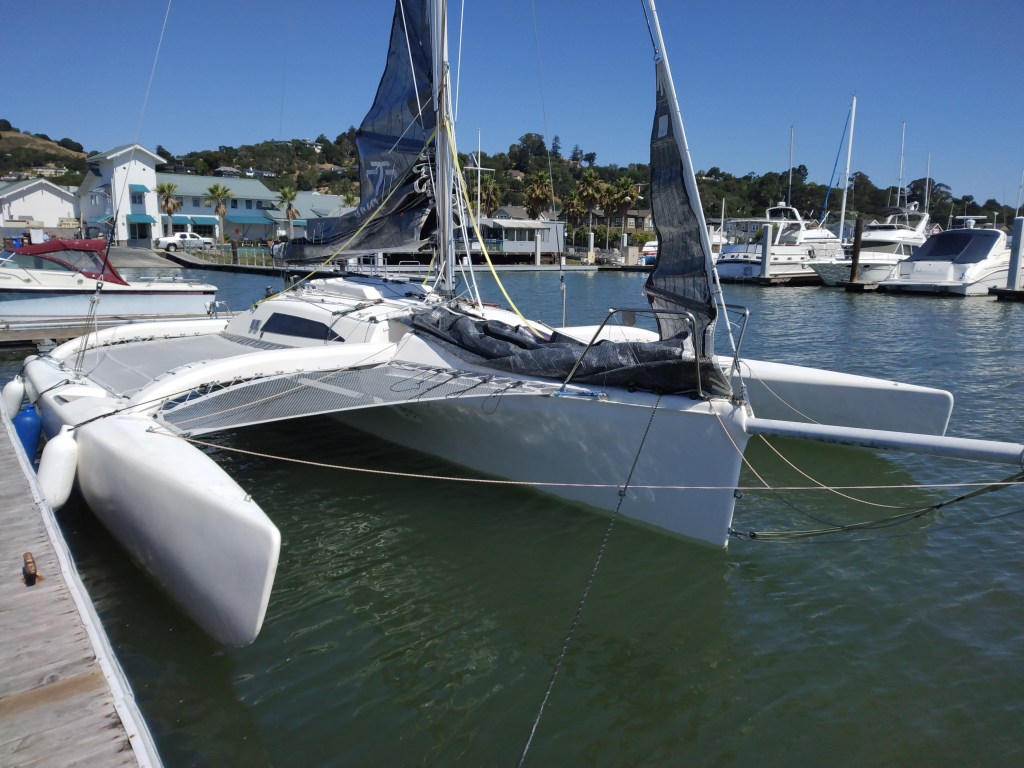
Corsair Marine | Models: F31, 970, and 880
– Known for: Performance and value.
– Ideal for: Sailors seeking speed and affordability with basic levels of comfort.
– Key features: Fold-able amas (fold in) allows the boat to fit into a single slip in marinas, semi comfortable accommodations. Great owners community.
– Ability to Trailer: Designed for effortless transport, the boat (when folded) features a street-legal width and can be loaded onto a trailer within minutes using a standard boat ramp. The mast can be lowered by one or two people using a gin pole, eliminating the need for a crane.
– Made in: Up to 2006 boats where made in Chula Vista, California USA. 2007 onward are made in Vietnam.
– Price to Value: Considered the overall winner due to its balance of performance and cost.
– Cost of a Used Boat: The price range for used F-31 and 970 models varies significantly, typically falling between $90,000 and $180,000.
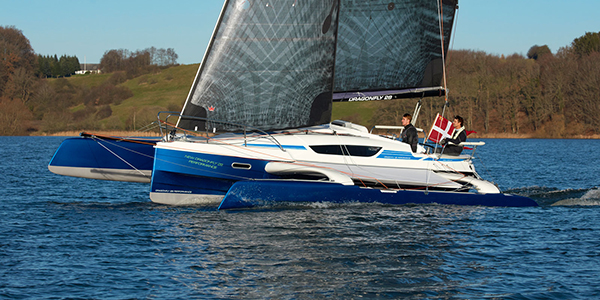
Dragonfly | Models: 28 and 31
– Known for: Interior and build quality.
– Ideal for: Cruisers who prioritize comfort and onboard amenities.
– Key features: Fold-able amas (swing out) to fit into single marina slips, high-quality finishes, and spacious interiors that enhance the cruising experience.
– Ability to Trailer: The Dragonfly 31 requires a time intensive preparation to trailer using a special trolley. It cannot be considered a load on / load off. The smaller 28 can be loaded onto a trailer using a boat ramp just like a Corsair.
-Made in: Denmark, Skærbæk, near Fredericia.
– Price to Value: Generally more expensive, due to the premium interior finishes and comfort.
– Cost of a Used Boat: The price range for a used Dragonfly 31 and/or 28 is typically between $125,000 and $250,000.

Seacart | Models: 30
– Known for: Outright performance.
– Ideal for: Sailors who intend to race almost exclusively.
– Key features: High-end construction materials, trailing requires disassembly due to its design.
– Ability to Trailer: The Amas need to be mechanically detached from the boat in order to trailer a Seacart. It is possible, but time consuming.
Made in: Built in Denmark in conjunction with Marström Composite AB Sweden.
– Price to Value: Considerably pricey, largely due to its carbon construction and race-oriented features.
– Cost of a Used Boat: The price range for a used Seacart 30 usually varies based on sails & inventory included and is about $130,000 and $240,000.

Rapido | Model: 40 (not under 40ft and not trailer-able)
Note: The Rapido 40 – should not be on the list of “under” 40ft, it’s important to also acknowledge that Dragonfly offers a 36 and 40-foot model and Corsair has a 36-foot model as well—none of which are trailerable without special oversize permits and specialty trailers. I decided to include the Rapido because it got a lot of media attention as of late.
– Known for: Extended Cruising while maintaining performance.
– Ideal for: Performance-oriented (affluent) sailors who value both speed and comfort.
– Key features: Sleek modern design , excellent performance, and comfortable accommodations.
– Ability to Trailer: No
– Made in: Vietnam
– Price to Value: Costly due to size and construction. No second hand market as of early 2025. Not trailer-able.
– Cost of a Used Boat: As of writing the Rapido is still too new to have a presence on the used market. A brand-new one typically costs between $700,000 and $800,000.
Summary:
By carefully evaluating these factors and understanding what each brand and model offers, you can make a more informed choice that aligns with your sailing aspirations and lifestyle. Whether you prioritize performance, comfort, or trailering capabilities, there’s a trimaran that can meet your needs and elevate your sailing adventures.
 Condor F31-1D C-Foil
You must be logged in to post a comment.